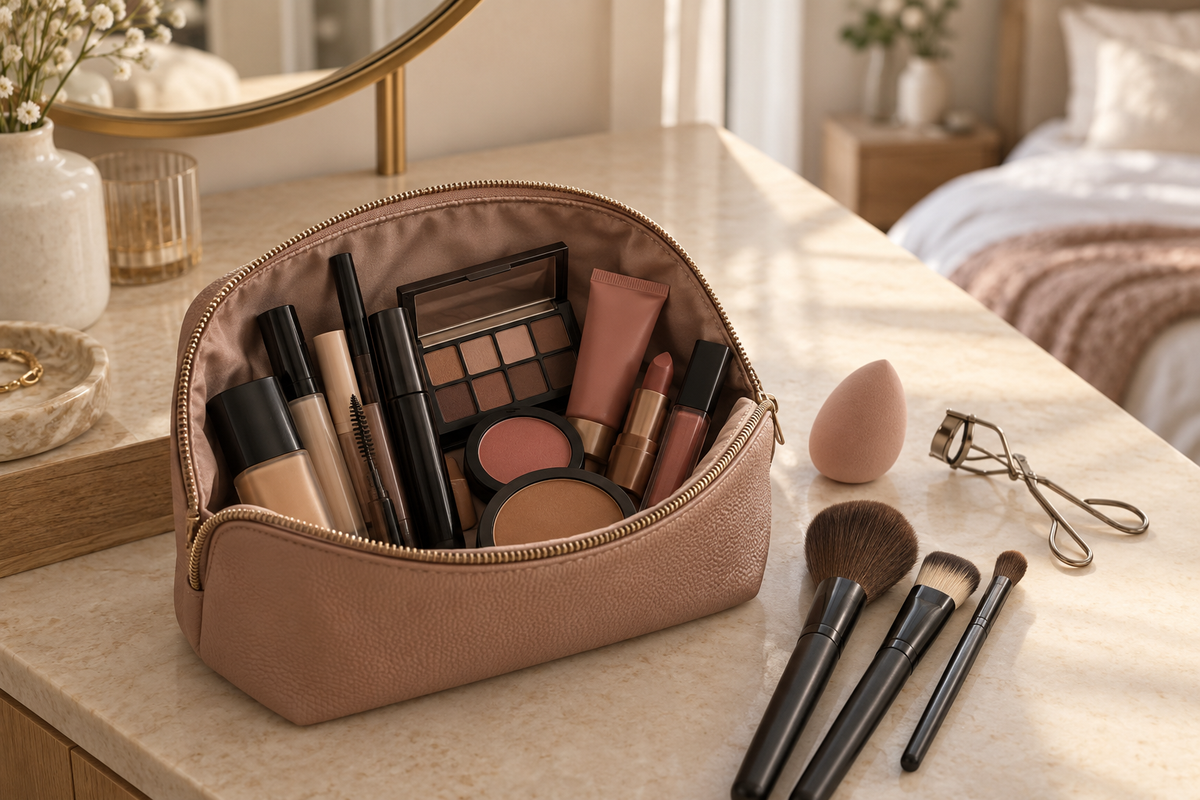
A small makeup collection is not defined by owning as little as possible. It is defined by usefulness: every product has a clear role, the shades work with your coloring and clothes, and the collection can create the looks you actually wear. The goal is a complete routine without five nearly identical versions of each category.
The short answer
Build your collection in six parts: base, brows, eyes, cheeks, lips and tools. Start with one dependable product per role, then add flexibility only where you regularly want a different coverage level, intensity or finish. A minimal capsule may contain 5–7 products; an everyday capsule about 8–12; a full but streamlined capsule about 12–18.
Start with the makeup you actually wear
Ignore the theoretical list of products every woman is supposed to own. Look at the last two weeks instead. Which products were used repeatedly? Which were used only for a real event? Which never left the drawer?
Separate your makeup into four groups: used weekly, used for specific occasions, duplicates and expired or unsuitable products. The weekly group is the start of the capsule. Occasion products must have a confirmed job. Duplicates should be compared side by side, not kept automatically.
The six-part makeup capsule
BASE → BROWS → EYES → CHEEKS → LIPS → TOOLS
This structure keeps the collection balanced without declaring every product type essential. Each part is a decision block. Base may mean concealer alone. Eyes may mean mascara alone. Tools may mean clean fingers and one brush. A capsule is successful when it supports your routine, not when every block contains the same number of products.
Base products: choose coverage by actual need
You do not automatically need skin tint, foundation, concealer and powder.
- Skin tint: useful for light, quick all-over evening when you enjoy sheer coverage.
- Foundation: useful when you regularly want more polished or consistent coverage.
- Concealer: useful for targeted correction and can be the entire base in a minimal capsule.
- Powder: useful only where shine, transfer or creasing needs control.
If skin tint and foundation create nearly the same result on you, keep the one you reach for. If the foundation only appears for genuine events, it can remain in the full capsule without becoming part of the everyday bag. Match complexion products to your present skin tone and undertone rather than keeping old shades for a hypothetical season.
Brows: one correction route first
A brow pencil and brow gel do different jobs, but not everyone needs both. Pencil corrects sparse areas and shape. Gel tints, textures and holds hairs. Choose the single product that solves your main issue for the minimal capsule. Keep both in the everyday or full capsule only when you reliably use them together.
Do not keep several pencils in nearly identical shades unless one has a meaningfully different finish or purpose. The best brow product is the one whose shade and application pressure remain predictable on a rushed morning.
Eyes: three versions, in order
The eye capsule follows a strict progression:
- Version 1: mascara only. This is the complete minimal route.
- Version 2: mascara + eyeliner. Add liner when you regularly want more definition.
- Version 3: mascara + eyeliner + shadow. Add one compact shadow palette for greater polish or variety.
Eyeliner alone is not treated as a substitute for the basic eye route, and the full version does not skip straight to a palette. This progression keeps the capsule usable at every level.
You do not need eyeshadow for everyday makeup if you do not wear it. When you do, one small group of shades that works with your usual clothes is more valuable than several palettes with overlapping browns and one novelty color each.
Cheeks and tone: color before complexity
Blush is the core cheek category because it restores color after complexion products. A cream or stick blush can be applied with fingers and may reduce tools. Bronzer adds warmth; contour creates shadow and definition. They are not mandatory partners.
Choose bronzer when warmth is the result you use. Choose contour when you genuinely sculpt. Highlight is optional, especially when your base or blush already has a luminous finish. A product advertised for eyes, lips and cheeks is only useful as a multi-use product if you like it in more than one of those places.
Lips: build by function, not by collecting shades
A useful lip capsule has distinct directions:
- Balm: easy moisture and minimal color.
- Everyday neutral lipstick: a more finished cream or satin option.
- Tint or stain: lighter-feeling color with a different wear pattern.
- Stronger lip: a deliberate color for an outfit or occasion you actually wear.
- Gloss: an optional shine finish, alone or layered.
- Pencil: optional definition when it materially improves the lip look.
For most everyday capsules, two or three lip directions are enough. Compare similar shades on the lips in the same light. If three products look almost identical once applied, keep the formula you prefer and stop replacing the same shade under new names.
Which products can do double duty?
Good double-duty products reduce decisions without compromising the result. Concealer can replace all-over base. A cream cheek product can work without a brush. A neutral shadow can add soft liner-like definition. A tinted balm can cover casual lip color and in-bag touch-ups.
Do not force double duty where hygiene, shade or formula makes the second use impractical. “Multi-use” is a benefit only when you actually like every use.
Tools worth owning
Start from the formulas you kept:
- A sponge or complexion brush is useful for liquid base when fingers do not produce the finish you want.
- One blush or powder brush can cover several face powders if cleaned appropriately.
- A small eye brush pair is enough for a simple shadow look.
- A lash curler is optional and should fit comfortably; it is not a universal essential.
Large brush sets often create the same duplicate problem as makeup. Keep the smallest set that applies the capsule, clean it on a repeatable schedule and replace worn tools rather than adding more.
How many products do you actually need?
| Capsule | Approximate product count | Best for |
|---|---|---|
| Minimal | 5–7 | Fast routine, low decision load, light coverage |
| Everyday | 8–12 | Daily flexibility with one more polished direction |
| Full but Streamlined | 12–18 | Coverage, eye and lip variety without a collector-sized stash |
These are practical ranges, not rules. Tools can be counted separately, and someone who wears no base or brow product may need fewer items. Product count is useful only when it exposes duplication.
How to audit your existing makeup
KEEP → DUPLICATES → GAPS → REPLACE → STOP
Keep
Keep products that work now: correct shade, comfortable formula, acceptable condition and repeat use.
Duplicates
Group products by role and finish. Swatch comparable shades together and keep the formula that performs best in your routine.
Gaps
A gap is a missing function that prevents a real look—not an empty category on a shopping checklist. If mascara, blush and balm already create your everyday face, eyeshadow is not automatically a gap.
Replace
Replace products that are expired, changed in smell or texture, uncomfortable, repeatedly fail, or no longer match. Follow manufacturer period-after-opening and storage guidance; do not use appearance alone to declare an old product safe.
Stop
Once every real role is covered, stop shopping the category until something is used up, stops working or a genuinely new need appears. A wish list with a waiting period is more useful than buying a fifth version to test.
Minimal vs everyday vs full capsule
Minimal Makeup Capsule
Use targeted concealer, one brow product, mascara, one blush or cheek stick and one lip product. Add a sponge only when needed. This is a finished collection, not an incomplete version of the larger one.
Everyday Makeup Capsule
Add skin tint, the second brow function, eyeliner, bronzer and two or three distinct lip directions. Keep the eye logic at mascara plus liner; shadow remains optional until it has a repeat job.
Full but Streamlined Capsule
Add a more polished complexion route, targeted powder, one neutral shadow palette, one useful sculpting product, lip definition or gloss, and the compact tools needed to apply them. Keep each addition distinct.
Build the capsule with MAREYN
The System below maps every role to verified product examples while keeping selection logic intact. Use the product cards to fill actual gaps, not to replace products that already work.
Which routine fits your goal?
Tap one choice below. We’ll open the matching version of the The Makeup Capsule System.
-
Minimal Makeup Capsule
About 5–7 products: concealer, one brow product, mascara, one cheek color and one easy lip.
-
Everyday Makeup Capsule
About 8–12 products: skin tint plus concealer, pencil and gel for brows, mascara plus eyeliner, blush and bronzer, and three distinct lip directions.
-
Full but Streamlined Capsule
About 12–18 products: flexible complexion coverage, complete brow and eye options, blush plus one sculpting route, several genuinely different lip finishes and a compact tool set.
What happens next? Your choice opens the full System, where you can select products and save your choices.
What to do next
Put the chosen capsule in one bag or tray and use only that group for two weeks. Note the missing functions—if any—rather than the products you simply feel tempted to buy. For a timed routine using the same eye and brow logic, continue with the 10-Minute Everyday Makeup Routine. For a smaller trip version, use the Travel Beauty guide. Specialty Halloween products belong in a separate occasion edit, covered by Easy Halloween Makeup Ideas.
Maintain the capsule you keep
Once the collection is edited, clean the tools with the Makeup Brush Cleaning guide. For a similarly compact approach to nails, use the Simple At-Home Manicure guide.
Frequently asked questions
Which makeup categories are actually essential?
For most everyday routines, start with base only if wanted, one brow route, mascara, one cheek color and one lip product. Tools depend on the formulas selected. Eyeliner, shadow, bronzer, contour, powder and gloss are optional expansions.
Do I need both foundation and skin tint?
No. Keep both only when they provide meaningfully different coverage or finishes that you regularly use. A small capsule can use skin tint, foundation or concealer alone.
How many lip products are enough?
Two or three distinct everyday directions are enough for many people: an easy balm, an everyday neutral and either a tint, stronger lip or gloss. Remove shades that look almost identical when worn.
Do I need eyeshadow for everyday makeup?
No. The minimal eye capsule is mascara only. The next level adds eyeliner; the full streamlined version adds one useful neutral shadow palette.
What should I replace versus keep?
Keep products that are the right shade, perform reliably and are in acceptable condition. Replace expired, changed, uncomfortable or consistently poor-performing products; fill only real functional gaps.