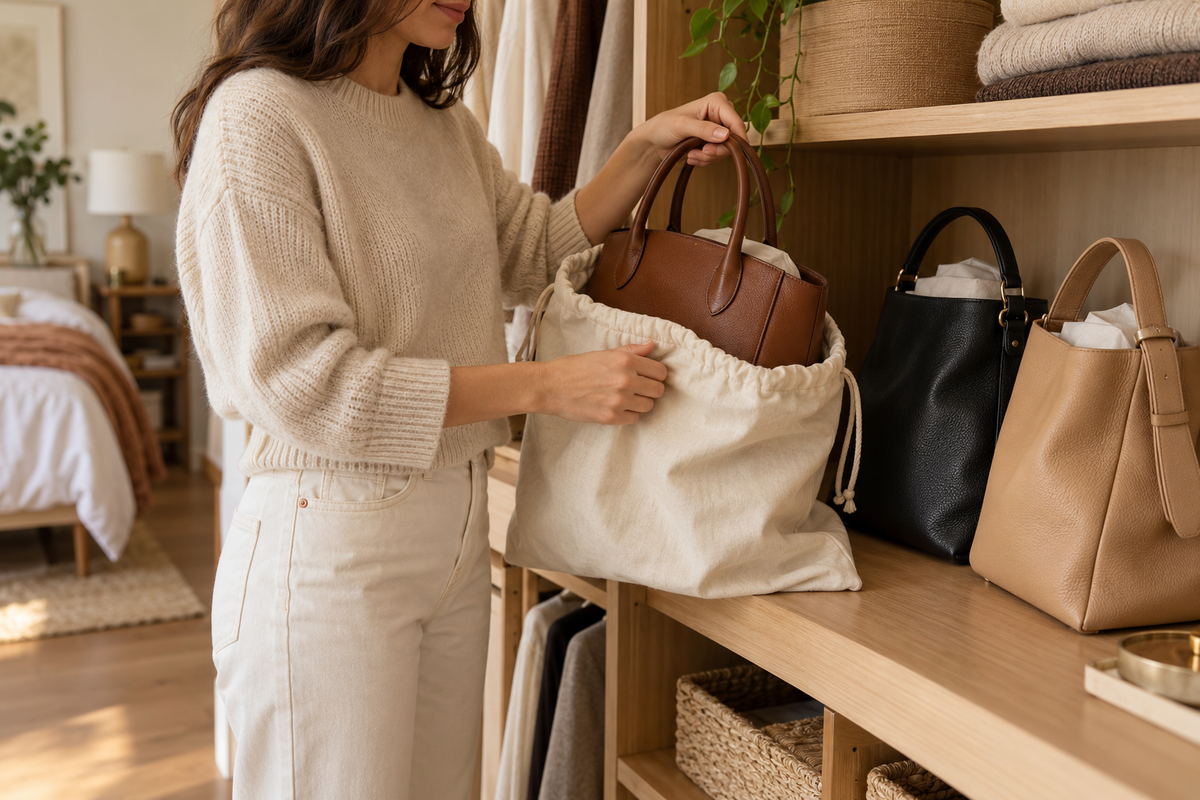
A handbag collection stays useful when care and storage are treated as one routine. The goal is not to display every bag or buy a wall of organizers. It is to keep the bags you use clean, supported, visible and easy to rotate without applying one cleaning method to every material.
The practical formula is edit → clean → support → cover → rotate. Start with maker instructions, use products only where they genuinely fit the material, and let the collection determine the storage.
How should handbags be stored?
Empty each bag, remove loose debris gently, close zippers or clasps without forcing them, and store the bag in the position recommended by its maker. Structured bags often benefit from light internal support and enough shelf space to stand without being crushed. A breathable dust cover can reduce dust while keeping the bag separate from neighboring items.
Avoid hanging heavy bags by their handles for long periods unless the maker specifically recommends it. Weight and gravity can strain handles or change the shape. Do not stack bags so tightly that hardware, straps or edges press into one another.
1. Edit and inspect the collection
Sort bags into everyday, occasional, seasonal, repair and release groups. Empty every pocket and remove old receipts, wrappers, pens and makeup that can leak. Inspect corners, handles, lining, stitching, zipper tracks and hardware.
If a handle is separating, a seam is opening, color is transferring or the material is peeling, pause before cleaning. A repair specialist or the brand may be more appropriate than a home treatment. The same repair-first logic appears in our Basic Clothing Repair guide.
2. Match care to the exact material
“Leather,” “suede,” “coated canvas,” “nylon,” “fabric,” “patent” and synthetic materials do not share one safe routine. Read the bag’s care label or brand instructions before using moisture, cleaner, conditioner or protective spray.
Begin with the least aggressive action: empty the bag, use a clean dry cloth where appropriate and remove loose interior debris without scraping the lining. For a compatible leather cleaner or conditioner, follow its directions and spot-test in an inconspicuous area when instructed. Never assume a product suitable for boots or furniture is automatically suitable for a delicate handbag finish.
3. Support shape without overfilling
Structured bags can collapse or develop deep creases when stored empty, but overstuffing can also distort seams and closures. Use clean, soft material or a correctly sized support that fills the main body gently. The bag should close naturally without pressure.
Remove heavy daily contents before storage. Water bottles, chargers, coins and full cosmetics pouches add weight and can change the base or handles over time.
4. Choose covers and shelf space
If the original dust bag is available and appropriate, reuse it. Otherwise choose a breathable cover sized to the handbag. Keep straps arranged so they are not sharply folded, and allow space between bags so hardware does not press into neighboring surfaces.
Use labels only if covered bags become impossible to identify. A small photo tag or simple written description is usually enough; a clear plastic storage wall is not necessary for most collections.
5. Make everyday rotation easier
Keep one small essentials pouch or a correctly sized organizer insert for items that move between bags. Edit that pouch regularly so switching bags does not mean transferring months of clutter. An insert should fit the interior without stretching the sides or changing the bag’s intended shape.
This weekly reset pairs naturally with the Weekly Wardrobe Reset: put away the previous bag, clear its contents and choose the next one for the actual week ahead.
The Handbag Care + Storage System
The System below separates stable care roles from specific products. Choose the version that matches the size and materials of your collection.
Which setup fits your wardrobe?
Tap one choice below. We’ll open the matching version of the The Handbag Care + Storage System.
-
Small Everyday Rotation
A few frequently used bags, medium covers, light shape support and a small transfer insert.
-
Structured Leather Collection
Maker-approved leather care, soft support and breathable storage with shelf spacing.
-
Small-Space Bag Rotation
Keep only the active rotation accessible; cover stored bags and transfer essentials with one insert.
What happens next? Your choice opens the full System, where you can select products and save your choices.
Three ways to build the system
Small Everyday Rotation
Keep a few frequently used bags accessible, use medium cotton covers for the stored pieces, support only the structured shapes and transfer essentials with a small organizer insert.
Structured Leather Collection
Prioritize maker-approved care, gentle internal support and breathable storage with enough room around handles, corners and hardware.
Small-Space Bag Rotation
Keep only the active rotation on the easiest-to-reach shelf. Store less-used bags covered and use one compatible insert to reduce clutter when switching.
How often should you clean a handbag?
There is no useful universal schedule. Empty everyday bags regularly and address spills or residue according to the maker’s directions. Material treatments should be driven by the bag’s condition and care guidance, not a fixed calendar or the assumption that more conditioning is better.
Can purse organizers damage a bag?
An insert can be useful when it fits correctly, but an oversized or rigid insert can push against the sides, alter the shape or add unnecessary weight. Measure the bag’s interior, choose a lighter fit and remove the insert when it is not helping.
What not to buy
- a different insert for every bag before checking whether one size can serve the active rotation
- a leather cleaner for bags whose material or finish is unknown
- large quantities of shapers when clean tissue or an existing soft support already works
- clear display cases for every bag when breathable covers and a shelf solve the problem
- more bags to make an organizer look full
Common handbag-care mistakes
- using one cleaner on leather, suede, coated canvas and synthetic bags
- storing bags with food, pens, cosmetics or moisture inside
- overstuffing a structured bag until seams are under pressure
- hanging a heavy bag by its handles for long periods
- placing hardware directly against another bag
- using an organizer insert that is too large
- packing the closet so tightly that bags are crushed
How handbag care fits into the rest of the wardrobe
Care works best as part of a restrained wardrobe routine. Use the Jewelry Care + Storage guide for smaller accessories, the Everyday Shoe Care guide for footwear, and the Seasonal Wardrobe Transition when deciding which bags should remain accessible.
For travel, use the same editing principle in the Weekend Personal Item Packing guide: choose one bag role that matches the trip rather than packing several near-duplicates.
Frequently asked questions
Should handbags be stored in plastic boxes?
Follow the maker’s storage guidance. For many everyday collections, breathable individual covers and adequate shelf spacing are simpler than sealed plastic storage, especially when material needs are uncertain.
Should I stuff every handbag?
No. Use gentle support only where the bag’s structure benefits from it. Soft or foldable bags may not need the same treatment as rigid, structured shapes.
Can I use baby wipes to clean a handbag?
Do not assume a general-purpose wipe is compatible with the bag’s material, dye or finish. Use the maker’s instructions and a product specifically confirmed for the exact surface.
How do I stop handbag clutter?
Keep a small transfer pouch for true daily essentials, empty the bag weekly and return occasional items to their own storage instead of letting every bag become permanent storage.